BUILD THE BLUEPRINT BEFORE YOU BUILD THE SOLUTION
BUSINESS ANALYSIS SERVICES FOR SMALL BUSINESSES
Whether you are adopting new software, streamlining daily operations, or preparing for your first autonomous AI Agent, technology is only as good as the instructions you give it. We translate your "tribal knowledge" into structured, crystal-clear business requirements—so you stop guessing, prevent costly rework, and get the exact results your business actually needs.
Magic is the Front-End
Plumbing is the Foundation
Here is the hard truth that big tech companies rarely tell small business owners:
Technology doesn't break. Unclear processes do.
Most small business owners know what pain points are slowing them down, but they don't have the time to document how their workflows actually run.
When you hire a developer, buy a new CRM, or try to deploy an AI workflow without a written blueprint, you end up accelerating the "hamster wheel"—spending time and money on solutions that miss the mark.
You cannot automate or improve a workflow that only lives in someone’s head.
At The AI OnRamp LLC, we bring decades of senior-level Business Analysis and requirements management experience directly to small businesses. We strip away the corporate red tape and give you clean, actionable documentation that bridges the gap between your business vision and real-world execution.
Who This Is For / Target Scenarios
Why "SmallBiz Requirements Analysis"?
Before You Buy Software: Know exactly what features your team needs before talking to CRM or ERP salespeople.
Before You Hire a Developer: Hand your technical team or agency a rock-solid blueprint so they don't bill you for guesswork.
Before You Deploy AI: Turn messy "tribal knowledge" into structured workflows ready for Microsoft 365, Google Workspace, or autonomous AI Agents.
Why Invest in SmallBiz Requirements Analysis First?
The Cost of a Blueprint is Pennies Compared to the Cost of Rebuilding the House.
Skipping the requirements phase doesn't save time—it just shifts the pain, confusion, and expense into the middle of your project when changes cost 10x more to fix. Here is the reality of what happens when you build a blueprint first versus when you "wing it":
The Benefits of Doing It Right (Building on a Foundation)
Stop Paying for "Scope Creep": When projects kick off with clear User Stories and pass/fail Acceptance Criteria, timelines stay locked in, developers stay accountable, and your budget is protected.
Eliminate "Single-Point-of-Failure" Risk: If your key operations manager took a two-week vacation tomorrow, would anyone know how to run their daily processes? We capture their "tribal knowledge" into structured Standard Operating Procedures (SOPs) and Use Cases that your company owns forever.
Buy Only What You Actually Need: Armed with an objective Requirements Document (BRD), you stop buying flashy "nice-to-have" features from software salespeople and invest only in tools that solve your real bottlenecks.
Plug-and-Play AI & Automation Readiness: When your "Happy Path" and edge cases are already mapped out on paper, transitioning repetitive work to Microsoft Copilot or Power Automate, Google Workspace, or custom AI Agents through ChatGPT, Gemini, or Claude becomes seamless rather than trial-and-error.
Faster Team Buy-In: Because we interview and include the people who actually do the daily work, your staff feels heard—turning potential technology skeptics into champions before launch day.
The Risks of Skipping It (Accelerating the "Hamster Wheel")
Automating Chaos: Bolting new software or AI onto an undocumented, broken workflow doesn't fix your operations—it just helps your business make mistakes faster.
Expensive "Shelfware" & Abandoned Tools: Nearly 40% to 60% of small business tech implementations fail or get quietly shelved after six months because the tool didn't match how the team actually operates in the real world.
Endless Developer & Vendor Finger-Pointing: Without a written "Definition of Done," any misunderstanding between what you meant and what the vendor built comes out of your pocket in change-order fees.
"Shadow IT" & Security Blind Spots: When leadership doesn't provide clear, documented workflows, employees cobble together their own unapproved apps and personal AI accounts—exposing your company and customer data to serious privacy risks.
Core Business Analysis Services
Enterprise-grade structure, right-sized and jargon-free for small business budgets and timelines.
Requirements Gathering & Discovery
The Plain-English Goal: Uncovering what you actually need (not just what you think you need).
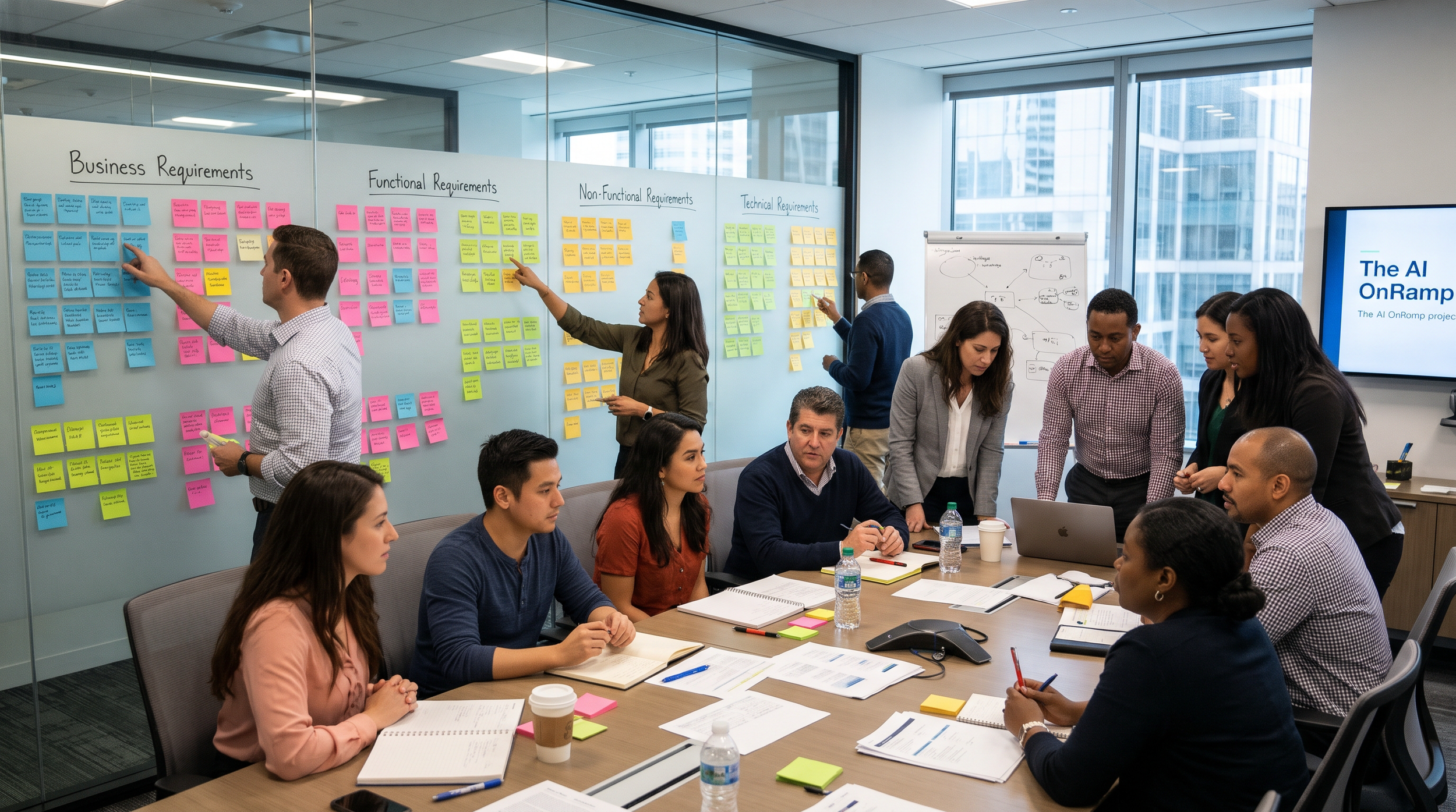
What We Do: Through structured, guided interviews and workflow walkthroughs with you and your team, we uncover hidden bottlenecks, identify operational gaps, and separate "must-haves" from "nice-to-haves" before you spend a dime on software or development.
Use Case Documentation & Process Mapping
The Plain-English Goal: Mapping the step-by-step journey from start to finish.
What We Do: We document exactly how a human—or an AI agent—interacts with your systems to accomplish a specific goal. We map out the "Happy Path" (when everything goes right) as well as the exceptions and edge cases (what happens when something goes wrong).
Acceptance Criteria & "Definition of Done"
The Plain-English Goal: No more moving goalposts or unfinished projects.
What We Do: How do you know when a project, software setup, or AI workflow is officially finished and working properly? We write crystal-clear Acceptance Criteria—a pass/fail checklist that defines exactly what must be true before a project is considered complete.
Requirements Documentation (BRD / FRD)
The Plain-English Goal: Your single source of operational truth.
What We Do: We organize your business rules, operational needs, and technical constraints into a clear, structured Requirements Document. Whether you use this internally or hand it to a technical team, everyone stays on the exact same page.
Agile User Stories
The Plain-English Goal: Keeping the focus on the people who do the work.
What We Do: We break down overwhelming projects into bite-sized, actionable User Stories using the proven Agile framework: "As a [type of user], I want to [perform an action], so that I can [achieve a specific business value]." This keeps your projects focused on delivering immediate, practical value.
AI & Automation Readiness Blueprints
The Plain-English Goal: Preparing your business for the Intelligence Revolution.
What We Do: High-performing AI Agents require structured instructions and defined guardrails. We turn your newly documented requirements and use cases into "load-bearing documentation"—giving you the exact prompts, rules, and workflows needed to deploy AI safely and reliably.
Remember the Critical First Component: YOUR DATA!
The Plain-English Goal: Helping your business recognize, understand, and maximize the potential value of its data through informed recommendations and strategic guidance.
What We Do: Every business possesses valuable data generated through its daily operations, customer interactions, transactions, and business processes. However, that data is not always organized, accessible, or structured to deliver its full potential. We evaluate your existing data practices, identify opportunities for improvement, and provide actionable recommendations for data optimization. Our role is to help you understand what you have, where opportunities exist, and what steps can be taken to make your data more valuable, accessible, and useful. We provide the expertise and direction; your organization retains complete control and responsibility for implementing any recommended changes.
Why It Matters: Data is one of your business's most valuable assets. It reveals patterns, identifies opportunities, exposes inefficiencies, and supports better decision-making. Before your business can fully capitalize on the Intelligence Revolution, you need to understand the quality, organization, accessibility, and potential of the data you already possess. Knowing where you stand—and what can be improved—is the first step toward unlocking its true value.
How We Engage:
Built on Trust, Confidentiality & Clarity
Every engagement between The AI OnRamp LLC and our small business clients follows strict NDA guidelines and RFP best practices.
Opening up your internal operations to an outside consultant requires trust.
When you engage The AI OnRamp LLC, we protect your business from day one with professional governance and transparent procurement procedures:
Strict NDA & Confidentiality Procedures: Your internal workflows, customer lists, and operational challenges are your competitive advantage. Before we conduct discovery interviews or review your internal processes, we execute a mutual Non-Disclosure Agreement (NDA) and adhere to strict data-privacy guidelines. Furthermore, we never feed your confidential business data or proprietary trade secrets into public AI training models.
RFP-Ready Proposals & Transparent Scoping: Whether your small business is inviting us to participate in a formal Request for Proposal (RFP) or requesting a direct project quote, we follow industry-best RFP procedures. Every engagement begins with a clearly documented Statement of Work (SOW), defined deliverables, transparent pricing, and our own pass/fail Acceptance Criteria—so you know exactly what The AI OnRamp LLC will deliver, when it will be delivered, and what it will cost.
The Illuminated Path
How Our Engagements Work
Step 1: Listen First (The Solution Review & NDA Alignment)
Serving clients nationwide across the Lower 48 via Zoom or Google Meet—and available in-person across Middle Tennessee—we start with a dedicated session to listen to your goals. Before we dive into your proprietary operations—or respond to your company's RFP—we put all applicable NDA guidelines in place so you can share your challenges with complete confidence.
Step 2: Clear Engagement Scoping
Following best-practice RFP and engagement standards, we provide a clear, jargon-free proposal outlining your exact project scope, timeline, and deliverables.
Step 3: Discovery, Capture & Translation
We observe your current workflows and interview key team members, translating messy notes and verbal explanations into clean, executive-ready Requirements, Use Cases, User Stories, and Acceptance Criteria.
Step 4: Review & Hand-Off
We walk you through the final blueprint in plain English. You walk away with a complete, professional documentation package ready to guide your team, your technology projects, or your next AI implementation.